
Dental Implant Care in NYC: How to Make Your Investment Last


A missing tooth affects more than just your smile. It can make chewing uncomfortable, change the way you speak, and over time may lead to changes in your jawbone structure. [1]
For many patients searching for dental implants in Upper East Side NYC, the goal is simple, they want a solution that looks natural, feels secure, and lasts for many years.
Dental implants are a modern tooth replacement solution designed to restore both the appearance and function of missing teeth. According to the National Institute of Dental and Craniofacial Research (NIDCR), tooth loss remains a common oral health concern among adults, and replacement options such as implants can help restore function and appearance. [1]
Whether you lost a tooth because of injury, severe decay, gum disease, or a failed bridge, understanding your options can help you make a confident decision.
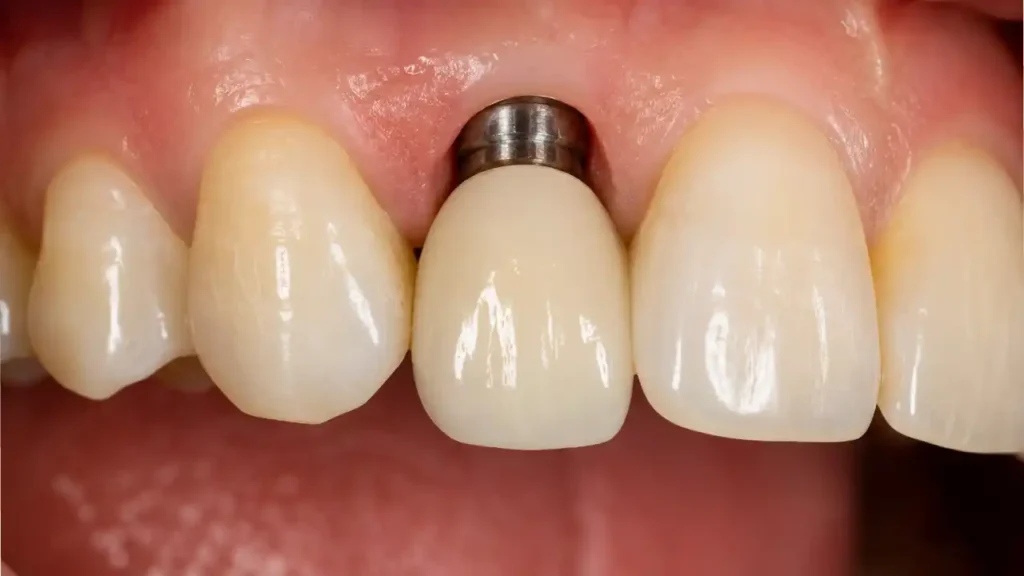
What Are Dental Implants?
A dental implant is an artificial tooth root made from biocompatible materials such as titanium or ceramic, which is surgically placed into the jawbone to support a replacement tooth. After healing, it supports a custom-made crown, bridge, or denture. [2]
A dental implant functions as a replacement for the natural root of a missing tooth. Unlike traditional dentures that sit on the gums, implants are fixed within the jaw, creating a stable foundation for replacement teeth.
A complete dental implant has three main parts:
- Implant post: The titanium or ceramic fixture placed inside the jawbone. [3]
- Abutment: A connector piece that joins the implant to the replacement tooth.
- Dental crown: The visible part that looks and functions like a natural tooth.
Osseointegration
The natural healing process where the jawbone gradually bonds with the dental implant, creating a secure foundation that contributes to long-term stability. [2]
Titanium Implant
A dental implant component made from a durable, biocompatible metal that has been extensively used in medical and dental applications for many years. [3]
Dental Crown
A custom-made dental restoration created to restore the natural appearance, shape, and everyday function of a tooth.
Why Are Dental Implants Considered the Gold Standard for Missing Teeth?
Dental implants are often considered the preferred tooth replacement option because they replace both the visible tooth and its root, helping preserve jawbone health while providing strong chewing ability. [6]
Some major benefits include:
Natural Appearance
Implants are made to look similar to your natural teeth in color, shape, and overall appearance. The crown can be matched to your natural tooth color and shape.
Improved Eating Ability
Unlike removable dentures that may shift while eating, implants are anchored into the jawbone, allowing many patients to eat more comfortably. [2]
Jawbone Preservation
When a tooth is lost, the jawbone underneath can begin to shrink because it no longer receives stimulation from chewing.
Research from the National Institutes of Health (NIH) explains that bone remodeling occurs after tooth loss, which is one reason early tooth replacement may be recommended in suitable patients. [2]
Long-Term Durability
With proper oral hygiene, regular dental visits, and healthy lifestyle habits, dental implants can last for many years.
Interactive Self-Assessment: Are You a Good Candidate for Dental Implants?
Answer these quick questions:
✓ Do you have one or more missing teeth?
✓ Are you tired of loose dentures or uncomfortable bridges?
✓ Do you have healthy gums?
✓ Do you have enough jawbone to support an implant, or are you willing to consider bone grafting?
If you answered “yes” to most of these questions, you may be a candidate for implant treatment. A dental examination and imaging scan are necessary to determine eligibility.
Why Get Dental Implants in Upper East Side NYC?
Choosing a dental implant provider in the Upper East Side allows patients to receive specialized care close to home, work, and neighborhoods such as Park Avenue and the 10021 ZIP code.
Patients searching for dental implants near 10021 or dental implants near Park Avenue NYC often look for convenience, advanced technology, and experienced implant professionals.
Benefits of Choosing a Local Upper East Side Implant Dentist
Easy Access to Follow-Up Appointments
Dental implants require multiple visits, including consultation, surgical placement, healing checks, and final restoration. Having a nearby dental office can make these appointments easier to manage.
Access to Advanced Dental Technology
Many modern implant practices use technologies such as:
- 3D CBCT imaging for detailed jawbone evaluation.
- Digital impressions for improved comfort.
- Computer-guided implant placement for greater accuracy.
Personalized Treatment Planning
Every patient has different needs. A good implant treatment plan considers:
- Number of missing teeth.
- Jawbone health.
- Gum condition.
- Medical history.
- Cosmetic goals.
- Budget and long-term expectations.
How Much Do Dental Implants Cost in Upper East Side NYC?
The cost of getting dental implants in Upper East Side NYC depends on several factors, including the number of implants needed, the materials used, and whether additional procedures are required. Single implants often start around $3,000 and can exceed $6,000, while full-mouth implant treatments such as All-on-4 may cost $20,000 to $50,000 or more per arch.
The final cost varies for each patient because no two mouths are exactly the same. A detailed consultation, digital imaging, and treatment plan are needed to determine your exact investment.
What Services and Procedures Are Covered in Dental Implant Costs?
A complete dental implant treatment involves several steps, and the total price usually includes more than just the implant screw itself.
A typical treatment may include:
| Treatment Component | Purpose |
|---|---|
| Initial Consultation and Examination | Evaluates oral health and determines whether you are a suitable candidate for dental implant treatment. |
| Digital X-rays or 3D CBCT Scan [2][3] | Provides detailed images of the jawbone, teeth, and surrounding structures to support accurate treatment planning. |
| Implant Placement Surgery | Places the titanium or ceramic implant post into the jawbone, creating a stable foundation for the replacement tooth. |
| Abutment | Acts as a connector between the dental implant and the final crown, bridge, or denture. |
| Custom Dental Crown | Creates a personalized restoration designed to match the shape, color, and function of your natural teeth. |
| Follow-Up Appointments | Allows your dentist to monitor healing, evaluate implant stability, and ensure successful integration. |
Some patients may also need additional procedures, such as bone grafting or gum treatment, which can increase the total cost.
Does Dental Insurance Cover Dental Implants?
Yes, some dental insurance plans cover dental implant treatment, but coverage varies significantly depending on your provider and policy.
Some insurance plans may contribute toward:
- The consultation.
- Imaging and diagnostic procedures.
- The crown placed on the implant.
- Certain parts of the surgical procedure.
Before starting treatment, patients should speak with their insurance provider to confirm information such as:
- Annual maximum benefits.
- Waiting periods.
- Coverage limitations.
- Whether the dental office is in-network or out-of-network.
For older adults, it is also important to understand that Original Medicare generally does not cover routine dental services, including most dental implants, although some Medicare Advantage plans may offer limited dental benefits. [4]
Patient Decision Guide: Which Option May Be Right for You?
Choose a Single Implant If:
You have one missing tooth. The neighboring teeth are healthy. You want a solution that does not affect surrounding teeth.
Consider Full-Mouth Implants If:
You have multiple missing teeth. Your current dentures feel unstable. You want a long-term fixed replacement.
Consider Traditional Dentures If:
You need a lower-cost temporary option. Surgery is not suitable based on your health evaluation.
What Type of Dentist Performs Dental Implants?
Several dental specialists can place dental implants, including periodontists, oral and maxillofacial surgeons, and some general dentists with advanced implant training.
Understanding each specialist can help you choose the right provider for your needs.
Periodontist
A periodontist is a dentist who specializes in the prevention, diagnosis, and treatment of gum disease and conditions affecting the supporting structures around teeth, including the jawbone.
A periodontist may be especially helpful for patients who have:
- Gum disease.
- Bone loss.
- Complex implant cases.
- A need for soft tissue or bone grafting.
Oral and Maxillofacial Surgeon
An oral surgeon specializes in surgical procedures involving the mouth, jaw, and facial structures.
They often manage:
- Complex tooth extractions.
- Severe bone loss cases.
- Jaw-related surgical procedures.
- Advanced implant surgeries.
General Dentist with Implant Training
Some general dentists complete advanced education in implant dentistry and may provide implant treatment for straightforward cases.
Dental Implants vs Bridges vs Dentures: Which Is Better?
Dental implants, bridges, and dentures all replace missing teeth, but they work differently. Implants are fixed into the jawbone, bridges rely on neighboring teeth for support, and dentures sit on top of the gums.
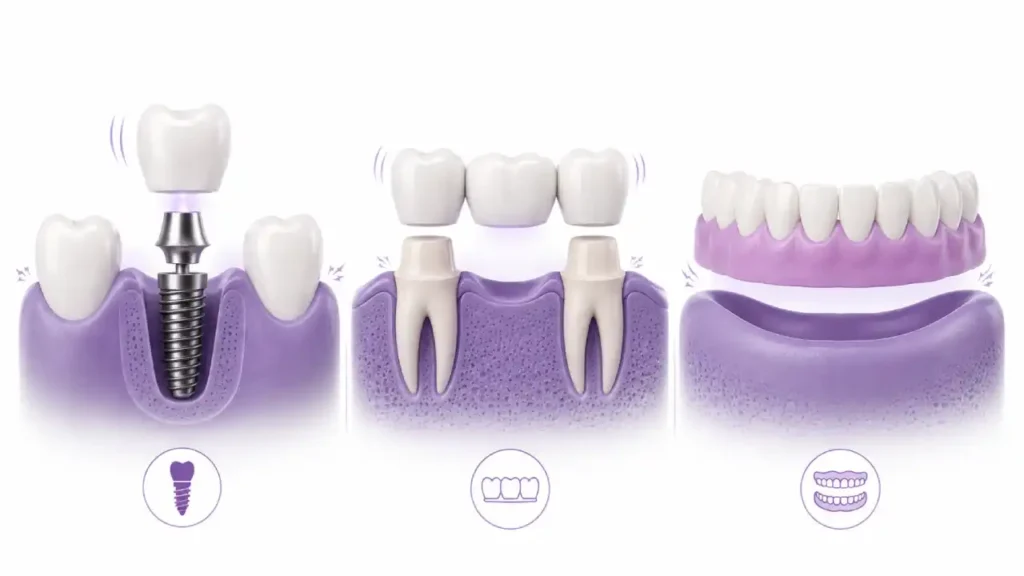
The best option depends on your oral health, budget, number of missing teeth, and long-term goals.
Comparison Chart: Dental Implants vs Bridges vs Dentures
| Feature | Dental Implants | Dental Bridges | Dentures |
|---|---|---|---|
| Replace Tooth Root | Yes | No | No |
| Affect Nearby Teeth | No | Usually requires modifying adjacent teeth | No |
| Stability | Very stable | Stable | May shift while eating or speaking |
| Jawbone Stimulation | Yes | No | No |
| Lifespan | Can last many years with proper care | Often requires replacement over time | May require adjustments or replacement |
| Daily Removal | No (fixed restorations) | No | Usually yes |
Benefits of Dental Implants
Natural Feel and Appearance
Dental implants are designed to look and function similarly to natural teeth. [6]
Protection of Nearby Teeth
Unlike traditional bridges, implants usually do not require grinding down healthy neighboring teeth.
Long-Term Solution
With proper care, many dental implants can remain successful for decades.
Limitations of Dental Implants
Higher Initial Cost
Implants usually cost more upfront compared with bridges or removable dentures.
Surgical Procedure Required
Implant placement involves oral surgery and a healing period.
Treatment Takes Time
The complete process can take several months because the implant must integrate with the jawbone through a process called osseointegration.
The Dental Implant Procedure: Step-by-Step Guide
The dental implant procedure usually involves a consultation, imaging, implant placement, healing, and attachment of the final replacement tooth.
The timeline varies depending on individual healing and whether additional treatments, such as bone grafting, are necessary.
Step 1: Dental Examination
Your dentist performs:
- Oral examination.
- Review of medical history.
- Digital X-rays.
- 3D CBCT imaging.
- Treatment planning.
This helps determine whether implants are a safe and predictable option.
Step 2: Tooth Extraction (If Needed)
If a damaged tooth is still present, it may need to be removed before implant treatment.
In some situations, an implant may be placed immediately after extraction, depending on bone condition and clinical factors.
Step 3: Bone Grafting (When Necessary)
A bone graft is a procedure that adds or encourages new bone growth in areas where there is not enough bone to support an implant.
Not every patient requires this step.
Step 4: Dental Implant Placement
During surgery, the dentist places the implant post into the jawbone under local anesthesia or other appropriate sedation options.
The implant acts as an artificial tooth root.
Step 5: Healing and Osseointegration
Most patients require several months for the implant to fully integrate with the jawbone, although healing times vary based on individual health, implant location, and treatment complexity.
During this stage, the jawbone grows around the implant, creating a stable foundation.
Step 6: Placement of the Abutment and Crown
After healing is complete:
- An abutment is attached to the implant.
- Digital impressions are taken.
- A custom-made crown, bridge, or denture is created and secured.
The final restoration is designed to match your natural teeth in color, size, and shape.
Does Getting a Dental Implant Hurt?
Most patients report that dental implant surgery causes less discomfort than they expected. The procedure is performed with anesthesia, and any soreness afterward is usually manageable with the dentist’s recommended pain management plan.
Recovery experiences vary based on:
- Number of implants placed.
- Whether bone grafting was performed.
- Individual pain tolerance.
- Overall health.
Always follow your dentist’s instructions regarding medications, diet, oral hygiene, and activity after surgery.
Dental Implant Recovery Timeline
| Time After Surgery | What You May Experience |
|---|---|
| First 24–72 Hours | Swelling, minor bleeding, and soreness are common during the initial healing phase. |
| First Week | Symptoms usually begin to improve, and your dentist may schedule a follow-up appointment to check healing. |
| 2–6 Weeks | Gum tissues continue to recover and adapt around the implant area. |
| 3–6 Months | Osseointegration continues as the jawbone gradually forms a strong connection with the implant. |
| Final Restoration | A custom crown, bridge, or denture may be attached once the implant has reached adequate stability. |
FAQs
1. Can You Get Same-Day Dental Implants in NYC?
Yes, some patients may qualify for same-day dental implants, also known as immediate-load implants, where a temporary tooth or restoration is attached on the same day the implant is placed.
2. Can Seniors Get Dental Implants?
Yes. Growing older does not automatically disqualify someone from getting dental implants. Many older adults can successfully undergo implant treatment when they have good overall health and healthy oral conditions.
3. Can Smokers Get Dental Implants?
Yes, smokers can receive dental implants, but smoking increases the risk of complications and implant failure. [5]
4. How Long Do Dental Implants Last?
With proper care, dental implants can last for many years, and many remain successful for decades.
5. Are Dental Implants Safe?
Yes. Dental implants have a strong history of safety and effectiveness when treatment is planned carefully, the patient is appropriately assessed, and the procedure is carried out by an experienced dental professional.
6. What Is the Success Rate of Dental Implants?
Dental implants have a high long-term success rate, with many clinical studies reporting success rates above 90% over many years in suitable patients.
7. How Do You Care for Dental Implants?
Dental implants require care similar to natural teeth, including daily cleaning and regular dental visits.
8. Are Dental Implants Better Than Dentures?
Dental implants are often considered a more stable and natural-feeling option compared with traditional dentures because they are anchored into the jawbone.
Interactive Patient Checklist: Are You Ready for Dental Implants?
Use this simple checklist before scheduling a consultation:
- You have one or more missing teeth.
- You are unhappy with a bridge or removable denture.
- You want a long-term replacement option.
- You are willing to maintain good oral hygiene.
- You understand that a professional examination is necessary to confirm eligibility.
If most of these statements apply to you, an implant consultation may help you explore your treatment choices.
Final Thoughts: Choosing Dental Implants in Upper East Side NYC
Missing teeth can make simple activities like enjoying your favorite foods or speaking clearly more challenging. Dental implants can help rebuild your smile by restoring both the look and performance of natural teeth.
Whether you need a single tooth implant, mini dental implants, full-mouth dental implants, or All-on-4 dental implants in the Upper East Side, NYC, the first step is a comprehensive evaluation with an experienced implant professional.
A personalized treatment plan can determine the most appropriate option based on your oral health, lifestyle, and long-term goals.
References & Sources
Al Dental Studio’s dental articles are carefully created using trusted dental knowledge and reviewed by experienced professionals to provide clear, accurate, and up-to-date information for patients.
View Sources
[1] National Institute of Dental and Craniofacial Research (NIDCR): Oral Health & Tooth Loss https://www.nidcr.nih.gov/health-info/tooth-loss
[2] National Institutes of Health (NIH) / National Library of Medicine (NLM): Dental Implant Research, Osseointegration, Bone Healing & Implant Treatment Studies https://www.ncbi.nlm.nih.gov/
[3] U.S. Food and Drug Administration (FDA): Dental Implants: What You Should Know https://www.fda.gov/medical-devices/dental-devices/dental-implants
[4] Centers for Medicare & Medicaid Services (CMS): Medicare Dental Services Coverage https://www.cms.gov/medicare/coverage/dental-services
[5] Centers for Disease Control and Prevention (CDC): Smoking and Oral Health https://www.cdc.gov/oralhealth/basics/adult-oral-health/smoking-and-oral-health.html
[6] National Library of Medicine (PubMed): Long-Term Clinical Research on Dental Implant Success and Survival
https://pubmed.ncbi.nlm.nih.gov/
Dental Experts, You Can Trust
Medically Reviewed. Last updated on June 17, 2026.
Learn more about our editorial standards.

Dr. Alexander Heifitz (Author)
Dr. Alexander Heifitz is the founder of AL Dental Studio in NYC, where he combines advanced dental expertise with a patient-first approach. He specializes in cosmetic and restorative treatments such as dental implants, veneers, Invisalign, and smile makeovers, helping New Yorkers achieve both oral health and confidence.

Book An Appointment
Looking for a reliable dentist in Upper East NYC? Whether you need a routine cleaning, urgent care, or a full smile transformation, we’ve got you covered. We accept most PPO insurance plans and offer flexible scheduling.
+1 (212) 430-3888
Call for appointment
Walk-ins Welcome / Same-Day Appointments Available

Related Blogs
Gum Disease Warning Signs | Treatment & Causes
Written by Dr. Alexander Heifitz, Founder of AL Dental Studio | Medically Reviewed. Last updated on April 5, 2026.
Read More
Top NYC Cosmetic Dentists Reviewed for Quality & Care
Written by Dr. Alexander Heifitz, Founder of AL Dental Studio | Medically Reviewed. Last updated on April 2, 2026.
Read More