
Hole in My Tooth: Complete Guide to Treatment, Pain Relief & Home Solutions


It is two in the morning. A sharp, throbbing pain shoots through your mouth, waking you up. Your tongue follows the source instinctively, and there it is: a tiny, surprising hole in your tooth. Panic strikes.
Your mind is racing with questions: “Is this serious? What is the price of this? Do I have an urgent dental appointment?
The Predicament You’re in
If you’re here, chances are you’re dealing with one or more of the following:
- A visible hole in your tooth causes sudden concern
- Sharp, shooting pain when eating, drinking, or even breathing in cold air
- Worry about expensive dental treatments.
- Uncertainty about whether it’s an emergency
- The urgent need for relief before you can reach a dentist
You’re not by yourself. Every year, millions of people go through this exact moment, and many of them make the same mistakes: putting off getting help, turning to risky home cures, or panicking without a clear plan.
The Good News: A cavity or hole in your tooth is highly treatable if you take the right steps right now. In fact, treating cavities early often leads to beautiful smiles. If you’re concerned about your overall dental appearance after treatment, explore smile makeover NYC options to enhance your results.
Why You Can Feel a Hole in Your Tooth With Your Tongue
Your tongue picks up changes your eyes can’t even see yet. So when you feel something off, a little dip, a rough edge that wasn’t there before, that’s nothing. That’s worth paying attention to.
A healthy tooth feels smooth. When decay eats through the enamel, it creates a small pit. Your tongue finds that pit. It feels like a tiny crater, sometimes rough around the edges, sometimes just a soft dip. Either way, it doesn’t feel like the rest of your tooth, and if your tongue found something, there’s something there.
Feeling the hole means decay has already broken through the enamel. It’s not the very early stage anymore. Don’t wait. Here’s why:
It’s not the very early stage anymore. If you want to understand what that early stage looks like, here’s what an early tooth cavity actually looks like before it becomes a hole.
- Decay doesn’t pause; it keeps going every single day
- The deeper it gets, the closer it gets to the nerve
- What’s a simple filling today could be a root canal next month
And if you feel it, but there’s no pain? That just means you caught it before it hit the nerve; that’s actually good news. But no pain doesn’t mean no problem. The hole is still there and still getting worse.
This is actually one of the biggest cavity myths people believe, that no pain means no cavity.
How to Relieve a Hole in Your Tooth Right Now | Home Remedies That Actually Work
You’re in pain. Maybe it woke you up. Maybe it hit you while eating. Either way, you need relief now, and you can’t get to a dentist in the next 10 minutes. I get it. Here’s what actually helps at home while you wait for your appointment.
Here’s what actually helps at home while you wait, and if the pain is coming from more than just the hole, here’s a full guide on how to help a toothache in general.
Ibuprofen is your best friend
Over-the-counter ibuprofen (Advil, Motrin) is genuinely the most effective pain reliever for tooth pain. It works because it reduces inflammation, and tooth pain is almost always inflammation-related. Take 200- 400 mg with food every 4-6 hours. Don’t wait until the pain is unbearable to take it. Stay ahead of it.
Cold press on the outside, not ice inside
Put an ice pack or a bag of frozen peas wrapped in a cloth against your cheek on the affected side, 15 minutes on, 15 minutes off. This numbs the area from the outside and reduces swelling. Don’t put ice directly on the tooth or inside your mouth. That can trigger a whole different level of sensitivity and pain that’ll make things worse fast.
Saltwater rinse, don't skip this one
Mix half a teaspoon of regular table salt into a glass of warm (not hot) water and swish gently for about 30 seconds. Spit it out, don’t swallow. Do this 2-3 times a day. It sounds simple, but it genuinely works; it reduces bacteria around the hole, calms inflammation, and keeps the area cleaner so it doesn’t get worse while you’re waiting to see a dentist.
Once you do see a dentist, they may also recommend fluoride treatment to help slow further decay around the area.
Orajel or clove oil for direct numbing
Dental numbing gel like Orajel has benzocaine in it, a real topical anesthetic. Dab a little directly into and around the cavity with a clean fingertip or cotton swab. It works fast, usually within a minute or two, but it wears off in 20-30 minutes. Clove oil (eugenol) is the natural version; a tiny amount on a cotton ball pressed to the tooth can help too. Both give real short-term relief.
Avoid the triggers
For now, no ice-cold drinks, no hot coffee or soup, no hard crunchy snacks, no sticky candy or gum. These will all aggravate the exposed area and make the pain spike. Stick to soft foods at room temperature: yogurt, mashed potatoes, bananas, lukewarm soup. Eat on the opposite side of your mouth as much as you can.
These remedies manage the pain. They don’t fix the hole. You may also notice a bad taste or smell coming from the area; that’s bacteria. Here’s what causes that bad smell from your mouth and what to do about it.
The decay is still progressing underneath, no matter how comfortable you get. Think of it like putting a bandage on something that needs stitches: helpful for now, but not a solution. Get to a dentist as soon as you can.
My Tooth Has a Hole, and It Hurts | Here's Exactly What to Do Right Now
Step 1: Rate your pain on a scale of 1 to 10
This one step tells you everything about how fast you need to move. Pain at 1-3 means you can book a regular appointment in the next few days; no panic needed. Pain at 4-6 means try to get seen today or tomorrow. Pain at 7-10 means you need to contact a dentist or emergency dental clinic right now, today. Don’t wait.
If the hole or pain is near your gum line specifically, that’s a slightly different situation. Read about tooth decay at the gum line and how it’s treated.
Step 2: Call your dentist
Do this before anything else. Even if it’s the evening, most dental offices have an emergency line or voicemail for urgent situations. When you call, say exactly this: “I have a visible hole in my tooth, and my pain is [number] out of 10.” That phrase gets you prioritized. Dentists know what that means, and they keep slots for exactly this kind of situation. Most patients who call and describe it clearly get seen within 24 hours.
While you wait, it helps to understand the best ways to treat a cavity so you know what to expect at your appointment.
Step 3: Manage the pain while you wait
Take ibuprofen, use the saltwater rinse, apply numbing gel if you have it. Don’t eat on that side. Don’t poke at the hole with your finger or a toothpick; that can make things worse. The full pain relief guide is in the section above this one.
Step 4: Watch for these warning signs
If any of these show up, don’t wait for a regular appointment; go to an emergency dentist or urgent care immediately. Facial swelling or jaw swelling. Fever above 101°F. Pain so severe that ibuprofen doesn’t touch it. Difficulty swallowing or opening your mouth. Visible pus or drainage near the tooth. These are signs the infection has spread beyond the tooth, and that’s when it becomes a real medical emergency.
Step 5: Don't use a temporary filling kit as a reason not to book an appointment
Those over-the-counter kits (Dentemp, Tempra, etc.) can cover the hole and give you a few days of relief. That’s all they do. They don’t kill the bacteria, they don’t stop the decay, and they can give you a false sense of security that makes you delay the real fix. Use them only as a bridge to get you to your actual appointment, not as a substitute for it.
That’s the plan. Five steps. The sooner you start, the simpler and cheaper this gets. A cavity caught early is a 30-minute filling appointment. The same cavity ignored for another month might become a root canal. It really does come down to timing.
What Exactly Happens When You Have a Hole in Your Tooth?
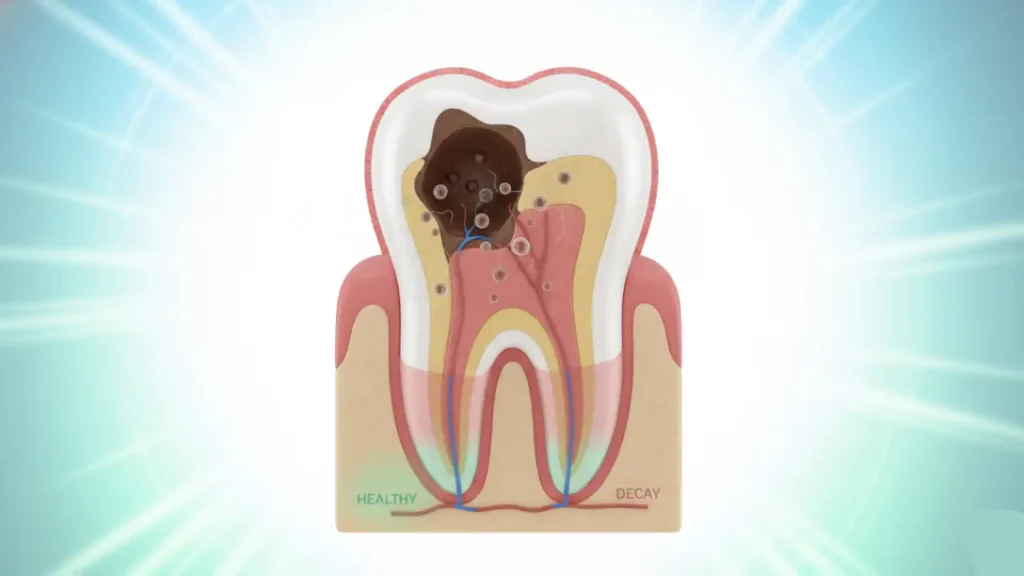
A cavity, also referred to as dental caries or a hole in your tooth, is a sign of advanced tooth decay that has actually caused an opening in the structure of your tooth. A hole in your tooth indicates that the protective enamel and the softer dentin layer underneath it have been destroyed by bacteria and acid that have gotten through several layers of tooth structure.
Early-stage decay is not the same as this. Decomposition is often painless and invisible in its early stages. However, the decay has advanced considerably once a hole appears that you can actually see or feel. Your tooth’s inner layers are constantly being attacked by bacteria, food particles, and acids through the hole, which exacerbates the condition every day.
How Does a Hole in Your Tooth Form?
The process of developing a hole in your tooth follows several distinct stages:
Stage 1: Enamel Destruction (Days to Months)
Bacteria colonizing the surface of your tooth are the first step in the formation of a hole in it. The protective enamel layer is gradually eroded by the acids produced by these bacteria. You won’t see anything or experience any pain during this stage. The decay is imperceptible and microscopic.
Stage 2: Dentin Invasion (Weeks to Months)
As acid keeps attacking, it breaks through the enamel and reaches the layer of dentin underneath. At this point, decay speeds up significantly because dentin is softer and more easily broken down than enamel. You may now become sensitive to foods that are hot, cold, or sweet. A noticeable discoloration or dark spot may appear on the tooth.
Stage 3: Visible Hole Formation (Weeks)
The structural damage is now severe enough that you can use your tongue to feel or see a hole in my tooth. Your tooth’s hole turns into a real opening. This is the reason why a lot of people look for answers to questions like “how to fill a hole in my tooth at home” or “what to do if I have a hole in my tooth.”
Stage 4: Pulp Involvement (Days)
The pulp chamber, which contains blood vessels and nerves, will eventually be reached if the hole keeps getting deeper. The kind of excruciating, throbbing pain that makes you say, “I have a hole in my tooth and it hurts,” at two in the morning, is brought on by this. Professional care is urgently needed at this point.
Stage 5: Abscess Formation (Days)
If left untreated, the infection may result in an abscess, or pus-filled pocket, at the tooth’s root. Fever, swelling, and possibly fatal complications result from this.
Why Does a Hole in Your Tooth Hurt So Much?
There is a specific physiological reason why a tooth hole can hurt. Knowing this pain mechanism makes it easier to understand why you need treatment right away.
The mechanism of sensitivity: The dentin layer of your tooth is made up of thousands of microscopic tubules, or tiny channels. External stimuli such as temperature, pressure, and chemicals can directly stimulate the nerves inside your tooth when a hole exposes these tubules. This explains why biting down on hard foods or eating ice cream causes excruciating pain when you have a hole in your tooth.
The Inflammatory Response: Bacteria cause inflammation as they spread farther into your tooth. Pain is made worse by the increased pressure inside the tooth cavity caused by this inflammation. The pain increases with the decay’s proximity to the nerve (pulp).
The Infection Factor: When bacteria reach the nerve chamber, they cause infection and abscess formation. This is one of several signs you need a dental checkup before minor issues become severe infections.
What Are the Early Signs That You Have a Hole in Your Tooth?
Several warning indicators show up before a hole gets big enough to see or feel:
Sensitivity of the teeth. Consuming hot beverages, ice cream, sweet candies, or acidic foods like citrus fruits causes you to feel sharp pain or discomfort. The sensitive dentin layer underneath is made visible by the thinning enamel, which causes this sensitivity.
Observable Discoloration: Your tooth surface develops a dark patch that could be black, brown, or gray. Bacterial colonization and early decay are indicated by this discoloration. This is often noticed weeks before a hole is actually visible.
Discomfort when chewing. Chewing on the afflicted side, particularly when biting down on something hard, causes mild to moderate pain. This is a sign that the decay has spread past the enamel.
Localized Bad Breath: You notice foul odor or bad taste coming from the area around the affected tooth. This is one of the most common gum disease warning signs and treatment indicators that bacteria have colonized your mouth.
Food is Constantly Getting Stuck. Food repeatedly gets trapped between teeth or in a specific spot on the affected tooth, no matter how thoroughly you clean it.
How Can You Feel a Hole in Your Tooth With Your Tongue?
Many people discover their cavity by feeling it. Here’s exactly what happens when you can feel a hole in my tooth with your tongue:
- The Tactile Discovery: With thousands of taste buds and touch receptors, your tongue is incredibly sensitive. You can pick up on even the smallest irregularities when you run your tongue over your teeth. An indentation, depression, or rough pit in the normally smooth tooth surface is what a hole in your tooth feels like. It differs greatly from your molars’ natural cusps and ridges.
- What You’re Actually Feeling: You are feeling the cavity’s edges where the decayed area and the tooth’s intact structure meet. In contrast to the smooth enamel of healthy teeth, the border feels rough or sharp. The pit itself might resemble a tiny crater that just barely fits your tongue.
- The Confirmation: There’s no question that something is amiss once you use my tongue to feel a hole in my tooth. People frequently ignore other warning signs before finally calling the dentist because of this tactile confirmation.
- Safety of Tongue Exploration: Being gentle is crucial, even though using your tongue to explore is safe and won’t harm anything. Avoid using a toothpick or your fingernail to pick at the cavity’s edge, as this could enlarge the hole and cause pain.
What Does a Visible Hole in Your Tooth Look Like?
When you have a hole in my tooth that’s visible:
Appearance Characteristics:
- A small to medium-sized pit or opening in the tooth surface
- Dark coloration, ranging from light brown to black
- Sometimes appearing as a white chalky spot (early decay) or dark crater
- On back molars, it may appear as a small hole on the chewing surface
- On the front teeth, it’s more visible to others and yourself
- On the side surfaces, it might look like an indentation or a chip
Size Variation: The size of the holes varies greatly. Some are big enough to accommodate a tiny pea, while others are pinhole-sized (only 1-2mm). A tiny hole close to the nerve hurts more than a larger hole in the outer layers, so size isn’t always a good indicator of pain intensity.
Progressive Changes: Without treatment, the hole gets bigger and darker over time as the decay spreads farther. A tiny dark patch first develops into a noticeable pit and then, possibly, a sizable cavity.
When Should You Be Concerned About "I Have a Hole in My Tooth and It Hurts"?
While all cavities require professional attention, certain pain patterns indicate you need urgent care:
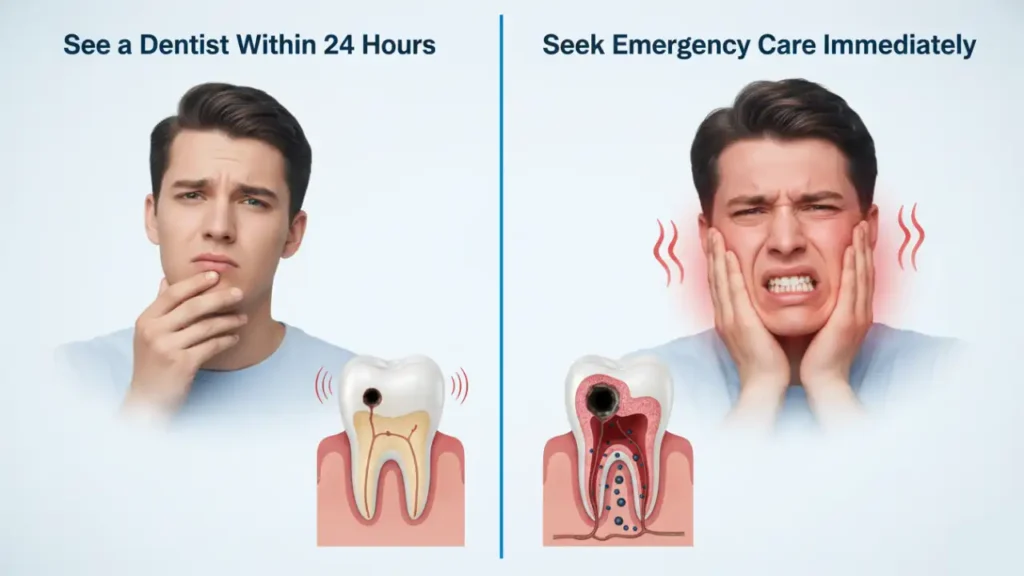
See a Dentist Within 24 Hours:
- Mild to moderate pain triggered by specific foods or temperature
- Pain that comes and goes
- Visible hole without severe pain
- Sensitivity to pressure when chewing
Seek Emergency Care Immediately:
- Severe, throbbing pain that doesn’t respond to over-the-counter pain relievers
- Constant pain that prevents eating, drinking, or sleeping
- Facial swelling on the side of the painful tooth
- Fever accompanying tooth pain
- Difficulty swallowing or opening your mouth
- Visible pus or drainage from the gum near the tooth
What Causes You to Have a Hole in Your Tooth?
Understanding the causes helps you prevent future cavities after treatment:
Poor Oral Hygiene: The most common cause of holes in teeth is inadequate cleaning. When you don’t brush thoroughly twice daily or fail to floss, plaque accumulates on your teeth. Proper brushing techniques combined with a consistent morning routine for healthy gums can prevent cavity formation entirely.
High Sugar and Acidic Diet: Bacteria in your mouth love sugar and starches. The combination of sugary foods and acidic beverages is devastating. Review the best and worst foods for better teeth to understand which foods accelerate cavity formation and which protect your teeth.
The combination is devastating: bacteria produce acid, and you’re also consuming acid. Frequent snacking, especially grazing on sugary foods throughout the day, is worse than eating all your sugar in one sitting because it constantly feeds cavity-causing bacteria.
Dry Mouth (Xerostomia): Dry Mouth (Xerostomia): Saliva is your mouth’s natural defense against cavities. It washes away food particles, neutralizes acids, and contains antimicrobial compounds. When you produce insufficient saliva (due to medications, autoimmune conditions, or radiation therapy), your cavity risk skyrockets. Learn more about dry mouth causes and natural solutions to protect your teeth.
Genetic and Inherited Factors: Some people are naturally more prone to cavities due to inherited enamel quality, saliva composition, or natural cavity-causing bacteria colonization. If your parents had many cavities, you’re statistically more likely to develop them despite excellent oral hygiene.
Medical Conditions: Diabetes significantly increases cavity risk because high blood sugar increases bacterial growth and reduces saliva production. Discover the important connection between oral health and diabetes to understand how managing your overall health protects your teeth.
Age-Related Factors: Children (ages 2-5) and teenagers develop cavities frequently due to dietary habits, developing motor skills for proper brushing, and the vulnerability of newly erupted teeth. Adults often neglect dental care due to busy schedules. Seniors develop root cavities because receding gums expose the softer root surface to decay.
Smoking and Tobacco Use: Tobacco stains teeth, increases bacterial growth, reduces saliva production, and impairs healing. Smokers have significantly higher cavity rates than non-smokers. Understanding how dental health affects overall health can motivate you to quit smoking.
How to Fill a Hole in a Tooth at Home?
Every day, people looking for quick relief search for answers to the question of how to fill a hole in their teeth at home. There are over-the-counter temporary filling kits available, but it’s important to know what they do and don’t do.
Common Temporary Filling Products:
Products with zinc oxide-based putty that form a temporary seal include Temparin, Dentemp OS, and generic store versions, which range in price from $5 to $15. These substances are authorized for short-term oral use and have been used safely for decades.
What these kits accomplish:
- Fill the hole so you can eat without pain
- Reduce sensitivity to temperature and pressure
- Create a temporary barrier against bacteria
- Provide pain relief for 1-4 weeks (usually 2-3 weeks)
- Allow normal functioning while waiting for professional treatment
- Does NOT remove underlying decay
- Does NOT kill cavity-causing bacteria
- Does NOT stop decay progression (it continues underneath)
- Does NOT prevent infection development
- Does NOT provide permanent solution
Below the temporary fill, the following is taking place: The risk of infection rises every day as bacteria keep growing, acid keeps destroying tooth structure, and the hole actually gets bigger and deeper. You’re just covering up the issue while the real one gets worse, not solving it.
Step-by-step application process:
- Prepare thoroughly (this step determines success): Brush gently, floss, rinse thoroughly, then dry the cavity completely. Even slight moisture causes kit failure.
- Prepare material: Roll putty between clean fingers into a small ball (pea-sized or slightly larger). Work quickly before it hardens.
- Insert into cavity: Gently push the putty ball into the hole. Press firmly, but don’t use excessive force. Fill completely and remove excess from the tooth surface.
- Shape and level: Use your finger or the provided tool to smooth the surface until level with the surrounding tooth structure. Remove sharp edges.
- Allow setting: Don’t chew for 1-2 hours. Most kits set initially in 5-10 minutes but need 20 minutes to 2 hours for full hardening. Use your tongue minimally during setting.
- Post-application care: For 24 hours, eat only soft foods on the opposite side. Avoid hard or sticky foods. Avoid brushing directly over the filling. Monitor for deterioration.
- Expected duration: 1-4 weeks typically, with 2-3 weeks being average. Factors reducing duration include chewing on the filled tooth, eating hard foods, and repeated meal exposure. When it fails, the cavity has worsened, and you’re back to square one.
When Should You Use a Temporary Filling Kit?
Temporary filling kits serve a specific purpose in specific situations. Using them wisely prevents problems; misusing them creates false security that delays necessary treatment.
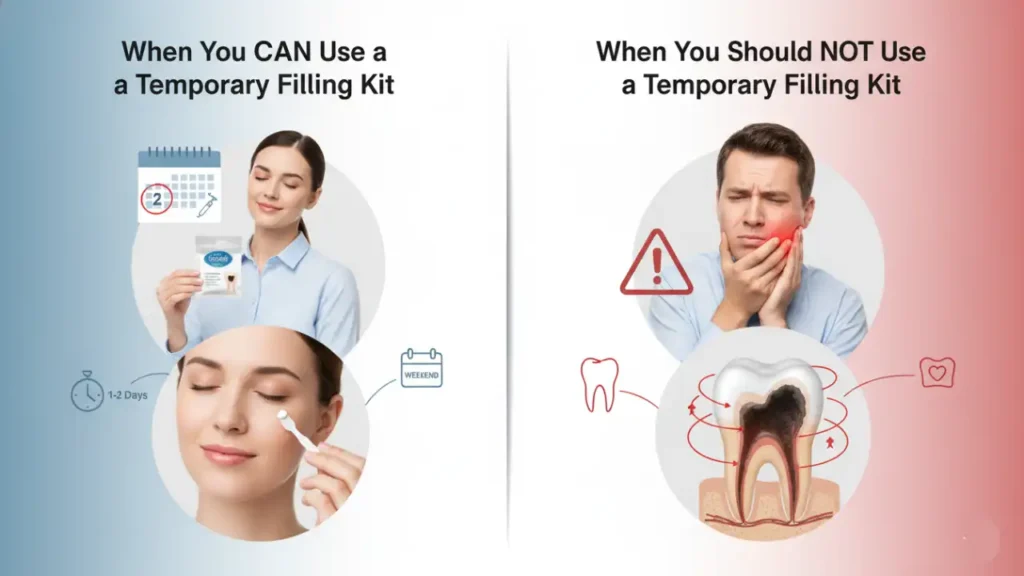
Acceptable situations for using temporary kits:
Within 48 hours, a professional appointment is scheduled. Tomorrow or the day after tomorrow is your dentist appointment. You can relieve your pain and resume your regular eating schedule until your appointment by using a temporary kit tonight.
I have an appointment with the dentist tomorrow, but I can’t get there today. You confirmed a same-day appointment by calling your emergency dentist line. To deal with the pain tonight, use the kit.
It’s Saturday night, you have an appointment on Monday, and your dentist has emergency hours on Monday. The weekend is bridged by the kit.
You live in a remote area with limited access, and although scheduling dental appointments is more difficult there, you have one set for the next one to two weeks. While overcoming scheduling constraints, the kit offers temporary respite.
When absolutely NOT to use temporary kits:
If you can see a dentist within a day, don’t use it. Simply wait. Professional care is far superior to do-it-yourself fixes.
Avoid using it if you have a fever or a swollen face. These suggest an infection that needs to be treated by a professional right away, not with makeshift kits.
Avoid using it if you are in a lot of pain. This suggests extensive decay that may have reached the nerve, necessitating an urgent professional assessment.
If you’re hoping this will take the place of medical care, don’t use it. Many believe they have found the solution by using temporary kits. They haven’t. Pain, not the cavity, is what you’re treating.
Don’t use it if you can’t schedule a professional appointment. If you’re considering using a temporary kit indefinitely because you can’t afford a dentist, talk to your dentist about payment plans. Many patients ask: does insurance cover dental implants in NYC? The same insurance typically covers cavity treatment at 70-80%, making professional care more affordable than you think.
Why You Should See a Dentist Instead of Using DIY Kits
When comparing DIY temporary fillings to professional dental care, the differences are dramatic:
What your dentist does that DIY kits cannot:
- Removes ALL decay (you cannot reach all decay areas yourself)
- Properly assesses cavity depth and whether it’s near the nerve
- Cleans and prepares the tooth correctly
- Uses professional-grade materials designed for durability
- Places temporary or permanent filling that lasts weeks or years
- Prevents infection development before it starts
- Creates a treatment plan addressing your specific situation
What DIY kits cannot do:
- Remove decay (you’re just covering it)
- Assess whether decay reached the nerve
- Prevent bacteria from continuing to multiply beneath the seal
- Provide solutions lasting longer than a few weeks
- Guarantee you won’t develop an abscess
Critical difference: A dentist removes the decay before sealing. You’re just sealing decay. These are fundamentally different approaches with completely different outcomes.
Immediate vs. future pain: The DIY kit provides immediate pain relief, making you feel like you’ve solved the problem. But the underlying decay worsens daily. In 2-4 weeks, when the temporary filling fails, the cavity is significantly larger and deeper. Now you need a crown instead of a simple filling, or worse, a root canal.
Why Professional Treatment Saves Money Long-Term
The cost difference between treating a cavity early versus treating complications is shocking:
The DIY Delay Cost Path:
- Day 1: Filling needed = $150-$300
- Day 7 (if ignored): Still filling-treatable = $150-$300
- Day 30: Decay reaches nerve, root canal needed = $700-$1,500
- Day 60: Tooth dies, extraction needed = $150-$600
- Replacement: Implant or bridge = $3,000-$6,000
- Total cost: $4,000-$8,000
Replacement options include dental implants ($3,000-$6,000) or implant-supported bridges vs dentures, both of which are significantly more expensive than early cavity treatment.
The Professional Treatment Path:
- Day 1: Schedule appointment
- Day 2-3: Professional appointment, get filling = $150-$300
- Total cost: $150-$300
Insurance perspective: Most dental insurance covers preventive care 100% and basic fillings at 70-80% coverage. Root canals and extractions are typically covered at 50%. The longer you delay, the more you pay out-of-pocket.
Time investment: One professional appointment now takes 30-60 minutes. Delayed treatment means multiple emergency appointments, time off work, and months of pain.
Professional treatment now saves your natural tooth. Delay might cost you the tooth entirely, requiring expensive dental implant cost NYC or bridge replacement procedures. Some patients also consider same-day dental implants NYC for faster restoration.
Simple math: Spend $200 now or $4,000+ later. The choice is clear.
Conclusion
It can be frightening to discover a hole in your tooth, particularly if the pain comes suddenly. In actuality, though, you have more power than you may realize. Quick action, safe pain management, and prompt dental care can mean the difference between a simple filling and a more involved, expensive procedure down the road.
Home cures and temporary solutions can keep you comfortable, but they cannot replace medical attention from a professional. Your chances of saving your tooth, avoiding infection, and lowering expenses increase with the timing of your dental appointment.
Remember, dental problems don’t heal on their own, but with the right steps, they’re completely manageable. If you’ve lost teeth to decay or complications, dental implants in Manhattan top clinics can restore your smile. However, prevention through timely cavity treatment is always superior to replacement.
Cate at AL Dental Studio
At AL Dental Studio, we help you understand why holes form in teeth and what to do next. We explain treatment options, pain relief, and safe home care in simple words. Our goal is to ease your discomfort and help you protect your tooth before the problem gets worse.
FAQs
1. Is a hole in your tooth the same as a cavity?
Yes, they’re the same thing. A cavity is just the dental word for a hole that forms when decay eats through your tooth. Different word, same problem.
2. What is a hole in a tooth called?
It’s called a cavity. Some dentists say “dental caries,” but that just means the same thing. Decay broke through the tooth and made a hole.
3. Can a hole in your tooth heal on its own?
No. Teeth can’t repair themselves once a hole forms. The only fix is a dentist cleaning out the decay and filling it. Waiting just makes it bigger.
4. I have a hole in my tooth but no pain. Do I still need to see a dentist?
Yes. No pain just means the decay hasn’t hit the nerve yet, that’s actually good news because the fix is still simple. But the hole is still getting worse every day. Go now while it’s easy.
5. Does a hole in your tooth always mean you need a filling?
Most of the time, yes. A small hole needs a filling. A deeper hole that’s reached the nerve may need a root canal first. The earlier you catch it, the simpler the treatment.
6. What happens if you leave a hole in your tooth untreated?
It gets worse. The decay spreads deeper, reaches the nerve, causes serious pain, and can lead to infection. A small filling today can turn into a root canal or tooth removal if you keep waiting.
7. Can a big hole in a tooth still be filled?
Sometimes yes, sometimes no, it depends on how deep it goes, not just how wide it is. A dentist needs to take an X-ray to see how far the decay has spread before deciding on the right treatment.
8. Where can I get a cavity filled near the Upper East Side in New York City?
Al Dental Studio is at 30 East 60th Street, Suite 608, just minutes from the Upper East Side. Dr. Alexander Heifitz has been treating cavities for over 30 years and can usually get you in quickly for an exam and a same-visit filling.
9. How much does it cost to fill a cavity at a dentist in NYC?
A basic filling in NYC typically runs between $150 and $400. At Al Dental Studio, most major insurance plans are accepted, and fillings are usually covered at 70-80%. Call ahead, and we’ll check your coverage before your visit.
Dental Experts, You Can Trust
Medically Reviewed. Last updated on February 16, 2026.
Learn more about our editorial standards.

Dr. Alexander Heifitz (Author)
Dr. Alexander Heifitz is the founder of AL Dental Studio in NYC, where he combines advanced dental expertise with a patient-first approach. He specializes in cosmetic and restorative treatments such as dental implants, veneers, Invisalign, and smile makeovers, helping New Yorkers achieve both oral health and confidence.

Book An Appointment
Looking for a reliable dentist in Upper East NYC? Whether you need a routine cleaning, urgent care, or a full smile transformation, we’ve got you covered. We accept most PPO insurance plans and offer flexible scheduling.
+1 (212) 430-3888
Call for appointment
Walk-ins Welcome / Same-Day Appointments Available

Related Blogs
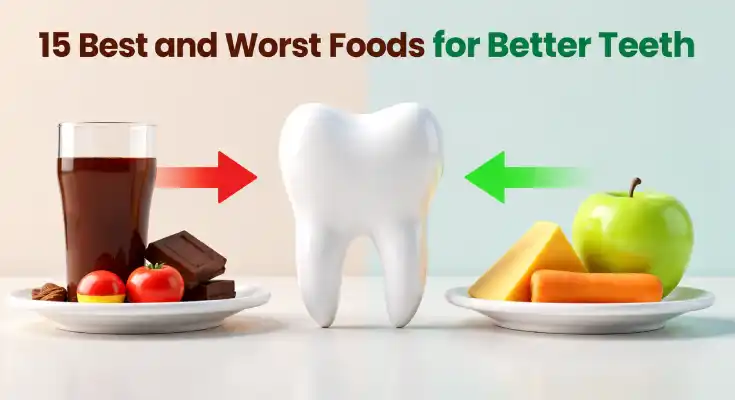
Best and Worst Foods for Teeth
Written by Dr. Alexander Heifitz, Founder of AL Dental Studio | Medically Reviewed. Last updated on April 8, 2026.
Read More
Dry Mouth After 50: Why it Happens & 15 Natural Solutions
Written by Dr. Alexander Heifitz, Founder of AL Dental Studio | Medically Reviewed. Last updated on April 8, 2026.
Read More